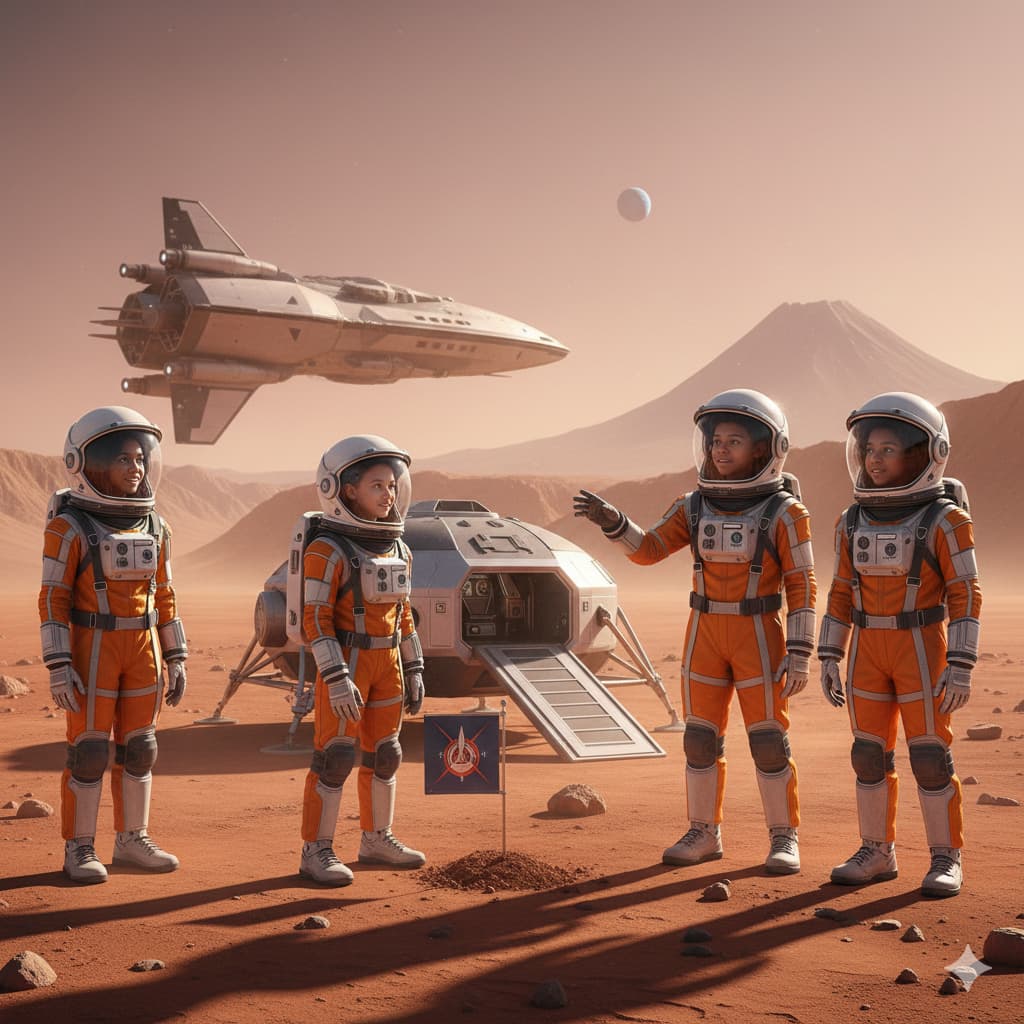
Captain Leo - Mission Commander
A natural leader with excellent problem-solving skills. At 14 years old, he's the youngest mission commander in history. He keeps the crew focused and makes tough decisions during the mission.
Dr. Maya - Science Officer
A 13-year-old genius in biology and chemistry. She's responsible for all scientific experiments on Mars and has a special talent for discovering hidden patterns in data.
Engineer Raj - Systems Specialist
At 12 years old, he can fix anything from rocket engines to communication systems. He built his first robot when he was 8 and speaks three programming languages fluently.
ROVER-7 - Robotic Assistant
The crew's intelligent robotic companion. It can analyze soil samples, map terrain, and even tell jokes to keep morale high during the long mission.
Narrator:
At the Kennedy Space Center, three young astronauts stood before the mighty Starship Discovery. After years of training and simulations, they were about to make history as the first children to journey to Mars.
Narrator:
The countdown echoed through Mission Control: "10... 9... 8... 7..." With each number, the excitement grew. This was more than a mission—it was humanity's next great leap into the cosmos.
Mars Mission Facts
Mars is called the Red Planet because of iron oxide (rust) in its soil. A trip to Mars takes about 7 months with current technology. Mars has the largest volcano in the solar system (Olympus Mons) and a canyon system (Valles Marineris) that would stretch across the United States!
"Crew, this is it! Years of preparation have led to this moment. Remember our training, trust each other, and let's make history together!"
"Destination: Mars - The Red Planet Awaits!"
Narrator:
For seven months, Starship Discovery traveled through the vast emptiness of space. The crew conducted experiments, exercised in zero-gravity, and watched Earth shrink to a tiny blue dot.
Narrator:
They celebrated Maya's 14th birthday in orbit, played chess with Mission Control, and learned everything they could about their destination. ROVER-7 kept them company with facts about Mars and stories from previous robotic missions.
"According to my calculations, we're seeing features on Mars that no human eyes have ever witnessed this closely. The data is incredible!"
Teamwork in Space: Living together in close quarters for months requires cooperation, patience, and good communication. The crew learned to work as one team, each member supporting the others.
Narrator:
As Mars grew from a red dot to a massive planet filling their windows, tension mounted. The landing would be the most dangerous part—entering Mars' thin atmosphere at 12,000 miles per hour and slowing down enough to land safely.
"Heat shield holding strong! Retro rockets firing in 3... 2... 1... We're slowing down! Prepare for touchdown!"
"Landing site confirmed: Jezero Crater. Atmospheric readings: 95% carbon dioxide, 2.7% nitrogen, 1.6% argon. Surface temperature: -63°C. Welcome to Mars, crew!"
"TOUCHDOWN CONFIRMED! We have landed on Mars!"
Narrator:
After extensive checks, it was time. Captain Leo opened the airlock door and became the first child to step onto Martian soil. His boots left the first human footprints in Jezero Crater in decades.
Narrator:
One by one, the crew emerged. They stood together on the rust-colored soil, looking at the pink sky and distant Martian hills. For a moment, they were silent, overwhelmed by the magnitude of their achievement.
"For all the children of Earth watching today—this step, this moment, is for you. If we can reach Mars, you can reach for your biggest dreams too."
Scientific Exploration: The crew's mission wasn't just to visit Mars—it was to explore, discover, and bring back knowledge that could help humanity understand our solar system and possibly find signs of past life.
Narrator:
On their third day of exploration, Dr. Maya noticed something strange in her soil analysis. A particular rock sample showed chemical signatures that shouldn't exist in ordinary Martian soil.
Narrator:
She called the crew together. ROVER-7 confirmed the finding: evidence of complex organic molecules—the building blocks of life! Not current life, but proof that Mars once had conditions suitable for life billions of years ago.
"This changes everything! We've found evidence that Mars once had lakes, rivers, and possibly even microscopic life! This is the most important discovery in the history of Mars exploration!"
Historic Discovery: Finding evidence of past habitability on Mars could help scientists understand how life begins and whether it exists elsewhere in the universe. Every new discovery adds another piece to the puzzle of our cosmic origins.
Narrator:
Just as they were celebrating their discovery, sensors detected an approaching massive dust storm—one of Mars' famous planet-wide storms that can last for months. They had less than 48 hours to secure their equipment and prepare the ship for departure.
"The storm is moving faster than predicted! We need to secure all external equipment and prepare for launch in 36 hours, not 48! Every minute counts!"
Crisis Response: In emergencies, teamwork becomes even more crucial. The crew divided responsibilities: Leo coordinated, Raj secured the ship, Maya packed the samples, and ROVER-7 monitored the storm.
Narrator:
For 36 tense hours, the crew worked non-stop. Martian winds howled outside, visibility dropped to zero, and dust began coating everything. But they worked together perfectly—each knowing exactly what to do, trusting each other completely.
"All systems green! Samples secured! Crew accounted for! ROVER-7, are we clear for launch?"
"Launch window optimal. Storm front approaching in 22 minutes. Countdown sequence initiated: 10... 9... 8..."
Narrator:
As the dust storm swallowed their landing site, Starship Discovery's engines roared to life. The ship lifted off, fighting against Mars' gravity and the howling winds.
Narrator:
They broke through the dust clouds into clear space, Mars shrinking behind them. In their cargo hold: priceless soil samples containing evidence of Mars' watery past and potential for ancient life.
"We did it! Not only did we survive a Martian dust storm, but we're bringing back discoveries that will rewrite science textbooks for generations!"
Narrator:
The seven-month return journey was filled with analysis of their samples, writing reports, and planning how to share their discoveries with the world. They had proven that young explorers could accomplish great things when given the opportunity.
"When we left Earth, we were just kids with a dream. Now we're returning as explorers who've walked on another world and made discoveries that will inspire millions."
Narrator:
When Starship Discovery finally returned to Earth, they were greeted as heroes. But more importantly, their mission inspired a new generation of young scientists, engineers, and explorers. They proved that age is no barrier to exploration when you have curiosity, courage, and teamwork.
"Our mission shows that the final frontier isn't just for adults. With education, preparation, and believing in each other, young people can achieve things once thought impossible. Mars was just our first stop—the universe awaits!"